Rice Pudding vs. Tapioca Pudding: Which One Should You Make?
Two puddings, one spoon, and a real decision to make. Rice pudding is the one that simmers on the back of the stove until the grains soften and the milk turns silky. Tapioca pudding is the one that gives back a little bounce, with translucent pearls suspended in cream. Both are old-fashioned, both are cheap to make, and both can go wrong in ways that are easy to avoid once you know what you're dealing with.
What separates them isn't just the starch. It's how that starch behaves in the pot, how long you'll stand there stirring, and what the finished bowl feels like on your tongue. Here's what to expect from each, and how to pick the one that fits the night you're actually having.
What's Actually in the Pot
Rice pudding starts with rice. Short or medium grain gives the creamiest result: Arborio, bomba, or plain Carolina-style rice break down at the edges and release starch into the milk, which is what thickens the pudding. Long-grain rice works too, but the grains stay separate and the finished bowl is looser. From there it's milk, sugar, a pinch of salt, often egg yolks for richness, and a warm spice like cinnamon, nutmeg, or cardamom.
Tapioca pudding starts with tapioca pearls, pure starch extracted from the cassava root. You'll find them as small pearls, large pearls, or instant tapioca granules that look like coarse sand. Milk, sugar, salt, eggs, and vanilla round it out. There's no grain and no chew from a kernel; the texture comes entirely from swollen starch.
Both are naturally gluten-free, which is worth knowing if you're cooking for a mixed table. Both also work with coconut or oat milk, though the finished pudding will be thinner and less rich than a dairy version.
Texture: The Real Difference
Rice pudding gives you two textures at once. The grains stay soft but distinct, sitting in a base thick enough to coat a spoon. Custard-style versions, made with tempered egg yolks, are silkier and richer. Baked versions develop a browned, slightly wrinkled skin on top that some people consider the entire point.
Tapioca is bouncy. The pearls swell into little translucent beads with a slight chew, suspended in a creamy base. The overall effect is lighter and more gelatinous than rice pudding, and people tend to either love it or find it odd. Small pearls give a smoother, more pudding-like result. Large pearls are chewier. Instant tapioca breaks down almost completely, so you get a smooth set with just a hint of graininess.
Want rice pudding looser? Thin it with warm milk. Want tapioca smoother? Use small or instant pearls and simmer them longer.
How the Starch Behaves
Rice starch thickens slowly and keeps thickening. A pot that looks perfectly loose on the stove will be noticeably firmer after an hour in the fridge. That's normal, and it's why you should pull rice pudding off the heat while it still looks a touch thin. Overcooked rice pudding turns gluey; undercooked rice stays chalky in the center no matter how creamy the surrounding liquid tastes.
Tapioca starch is faster and less forgiving. Pearls need to cook until they're fully translucent. Any opaque white center means raw starch and a chalky bite. Once they're there, stop. Boiling tapioca hard or cooking it too long turns the batch rubbery, and reheating it repeatedly breaks the gel down until the pudding turns watery. Rice pudding reheats much more gracefully.
Cook Time and Effort
Neither is difficult, but they ask for different things. Roughly:
- Stovetop rice pudding: 45 to 60 minutes, stirred every few minutes so the bottom doesn't scorch.
- Baked rice pudding: 10 minutes of prep, then 60 to 75 minutes in the oven with no stirring at all.
- Pearl tapioca: 20 minutes of soaking (or overnight), then 20 to 30 minutes of cooking with fairly frequent stirring.
- Instant tapioca: 15 to 20 minutes start to finish, and it sets as it cools.
If you want to be mostly hands-off and the oven is free for an hour anyway, bake rice pudding. If you want dessert in under half an hour, instant tapioca wins. If you want the ritual of standing at the stove with a wooden spoon, either works, though rice pudding rewards patience more.
Serving Styles and Pairings
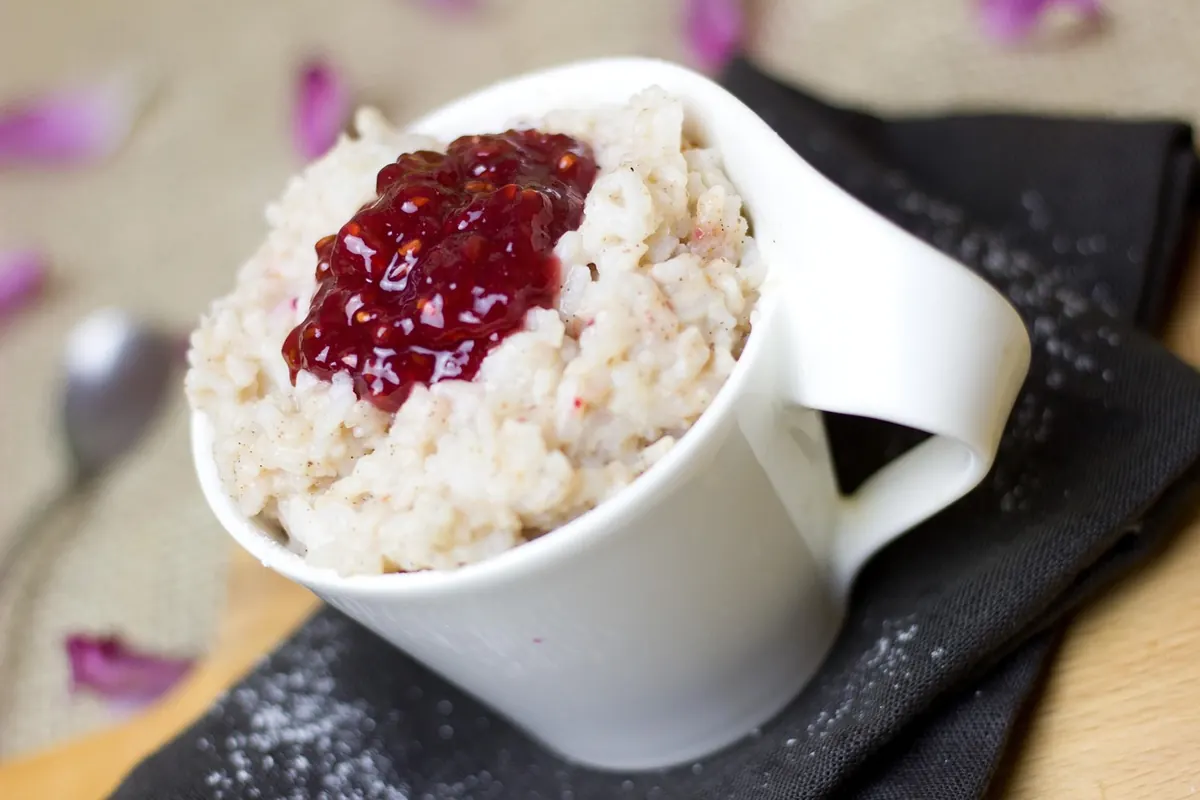
Rice pudding is flexible about temperature. Serve it warm from the pot, at room temperature, or cold from the fridge. Cinnamon, cardamom, vanilla, lemon zest, raisins, and dried cherries all fit. Top it with whipped cream, caramel, toasted almonds, or a spoonful of jam. Scandinavian rice porridge is looser and served with butter and cinnamon sugar; Indian kheer simmers longer and often finishes with saffron and pistachios.
Tapioca is at its best cold. Chilled in small cups or ramekins and topped with berries, diced mango, passionfruit, or a swirl of jam, it looks elegant for very little work. A coconut milk version with lime zest makes a solid dairy-free dessert. Warm tapioca is comforting, but the texture reaches its peak once fully chilled and set.
Mistakes That Ruin Each One
Rice Pudding
- Scorching the bottom. Use a heavy saucepan and stir the corners, not just the center.
- Adding all the sugar up front. Sugar slows the rice from softening. Add most of it near the end.
- Curdling the eggs. Temper them: whisk a ladle of hot milk into the yolks, then return the mixture to the pot over low heat.
- Serving it too thick. It sets as it cools. Loosen with warm milk right before serving.
Tapioca Pudding
- Skipping the soak. Pearl tapioca needs it, or the centers stay chalky.
- Boiling hard. A gentle simmer is enough. Hard boiling makes it rubbery.
- Pulling it early. Wait for full translucency, not almost.
- Reheating it several times. It thins out. Make what you'll eat in a day or two.
Which One Should You Make Tonight?
Pick rice pudding when you want comfort, when you have rice in the pantry, and when you're happy to let a pot simmer while you do something else. It's the better choice for a holiday table, a cold evening, or a crowd, and it holds up well the next day. Baked rice pudding especially gives you a dessert you can slide into the oven before dinner and forget about.
Pick tapioca when you want something lighter, when you need dessert quickly, or when you're serving it in glasses with fruit on top. It's a good make-ahead choice for a dinner party, and it's the more memorable of the two in the sense that people have opinions about it.
And if you can't decide, make a small batch of each. They cost almost nothing, and one bowl of each will tell you more than any description can.
You Might Also Like
Doubling a custard recipe takes more than multiplication. Learn which ratios to scale, how pan depth drives bake time, and how to chill safely for a crowd.
How oat, soy, almond, and coconut milks behave in dairy-free pudding, plus the starches, agar, and gums that deliver either a soft spoonable set or a firm sliceable one.